ClearWork runs AI interviews with the people who never make it to the workshop, then turns what they know into process maps, requirements and SOPs — every line traced to its source.
A workshop gets you the version people are willing to say out loud in front of their manager. Here's the same process, drawn both ways.
Clean, linear, and wrong in five places.
Every dotted line is real, load-bearing, and lives only in someone's head.
Nobody is hiding any of this. It just never came up.
The person who runs the exception does it so routinely they don't register it as unusual. The one who knows the real approval threshold wasn't in the room. And everyone describes the process as designed, because that's the version that sounds correct out loud. You find out in UAT, at go-live, or when a client says you told me this during the sales cycle and you have nothing to point at.
You can't retrieve your way to knowledge that was never recorded. Someone has to go and ask — and then keep the answer somewhere it survives.
The question isn't whether an AI could produce this.
It's who maintains it on Tuesday.
Correct something in ClearWork and it becomes a fact the system honours from then on. Every artifact built on it re-surfaces for review.
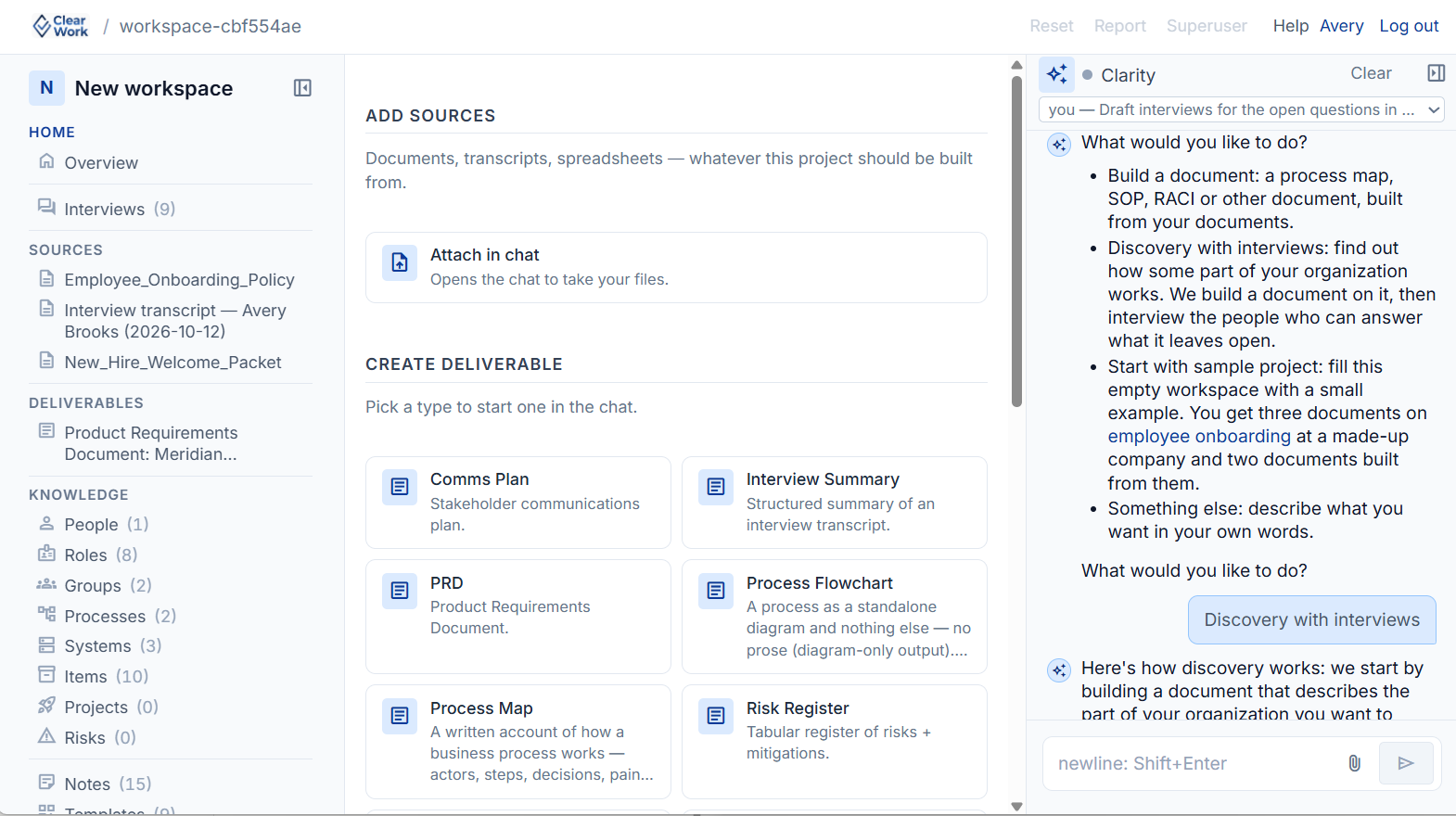
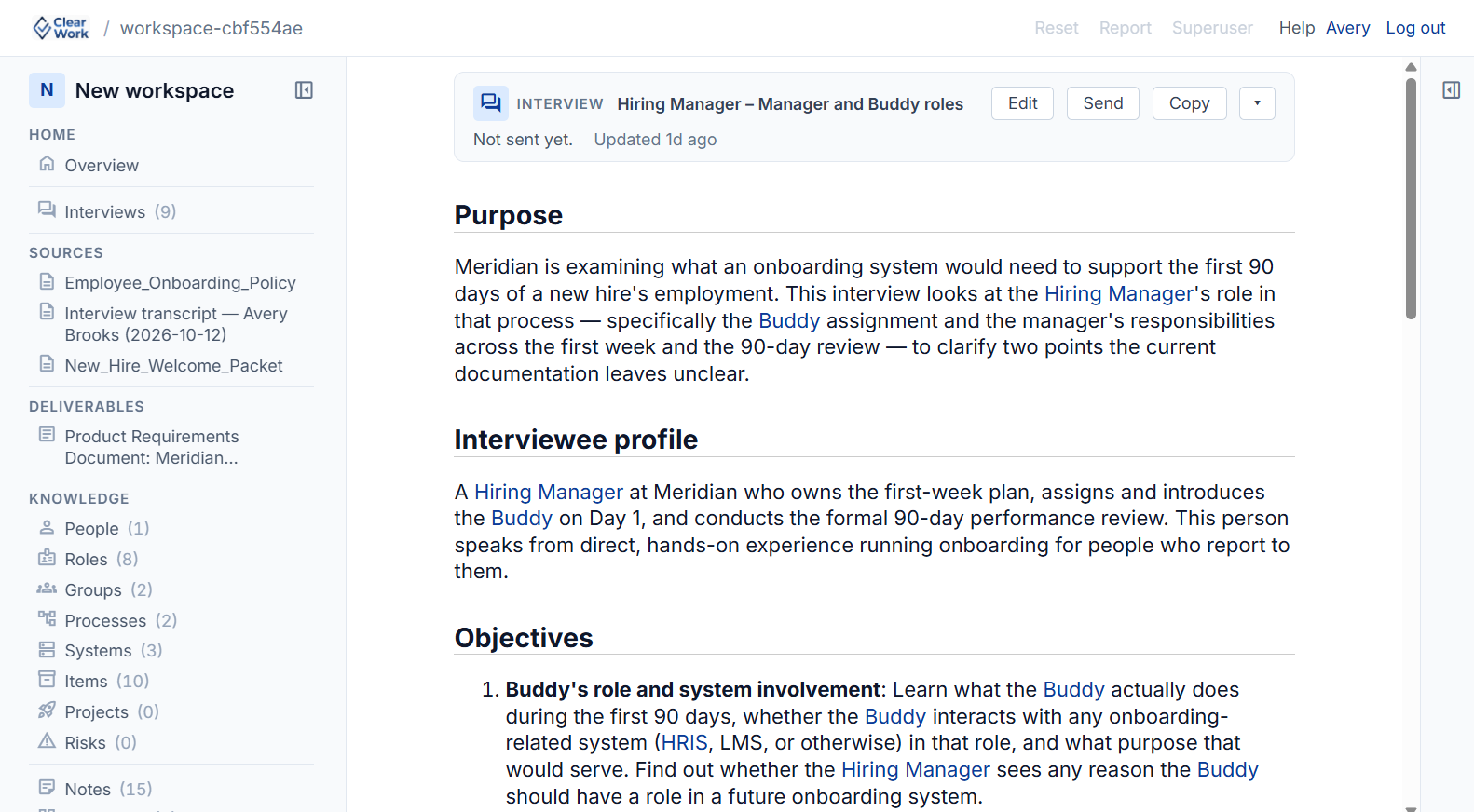
ClearWork works out what's missing from what you've already got, then sends targeted asynchronous interviews to the people who can close each gap — on their own time.
Documents, decks, SOPs, spreadsheets, transcripts and recordings. Many teams never use AI interviews at all — they run discovery as they always have and upload what comes out. That works completely.
Questions generated from the actual gaps, by role. Plus a narrated day-in-the-life recording — so the SME shows you the real workflow instead of describing it.
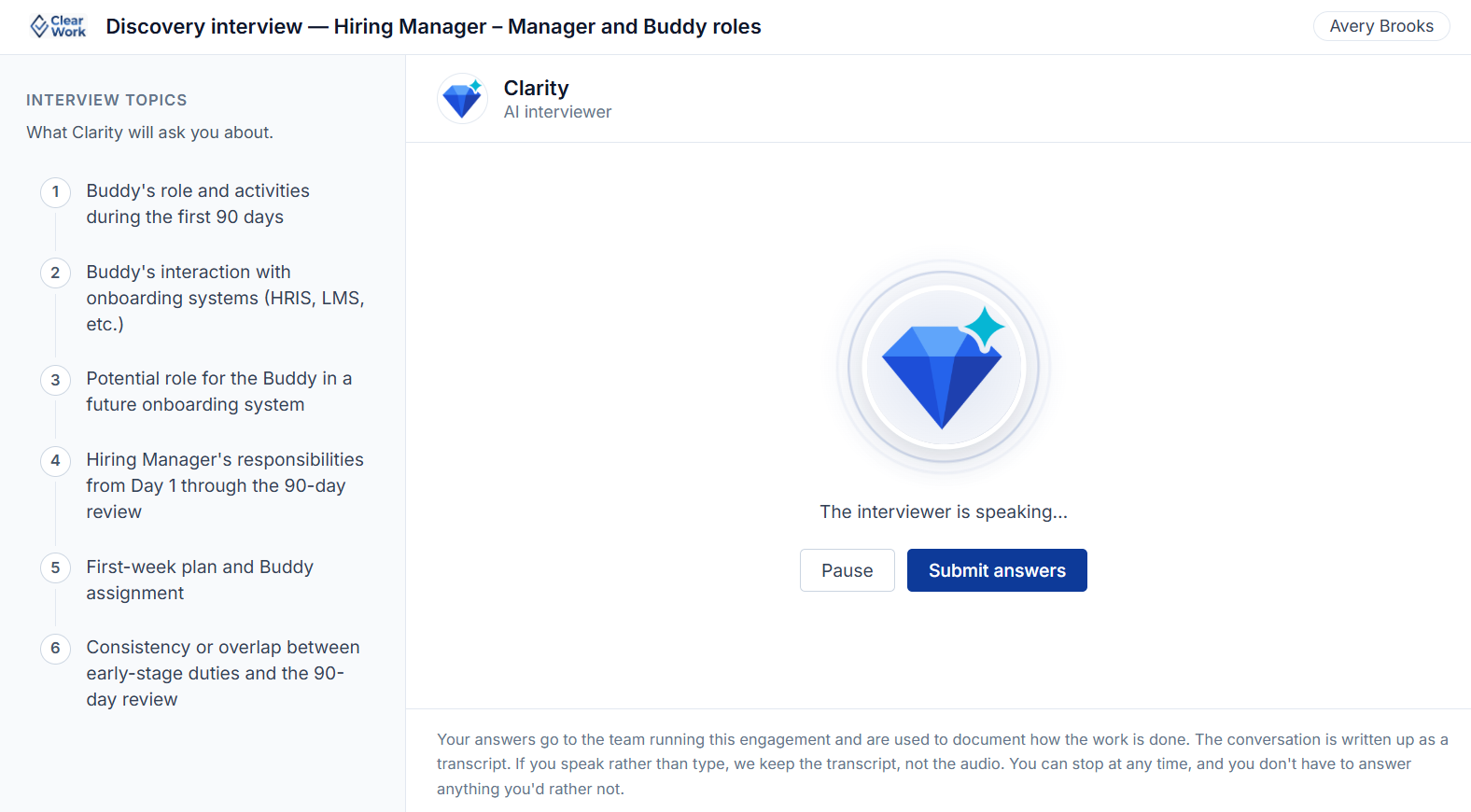
A conversation by voice or chat that follows up on ambiguity and asks the second question — whichever the SME prefers, on their schedule rather than yours.
Async interviews reach the people who'd never make the workshop. Whether your organisation uses them depends on its culture — some clients use them constantly, others upload transcripts and never touch them. Both produce the same record.
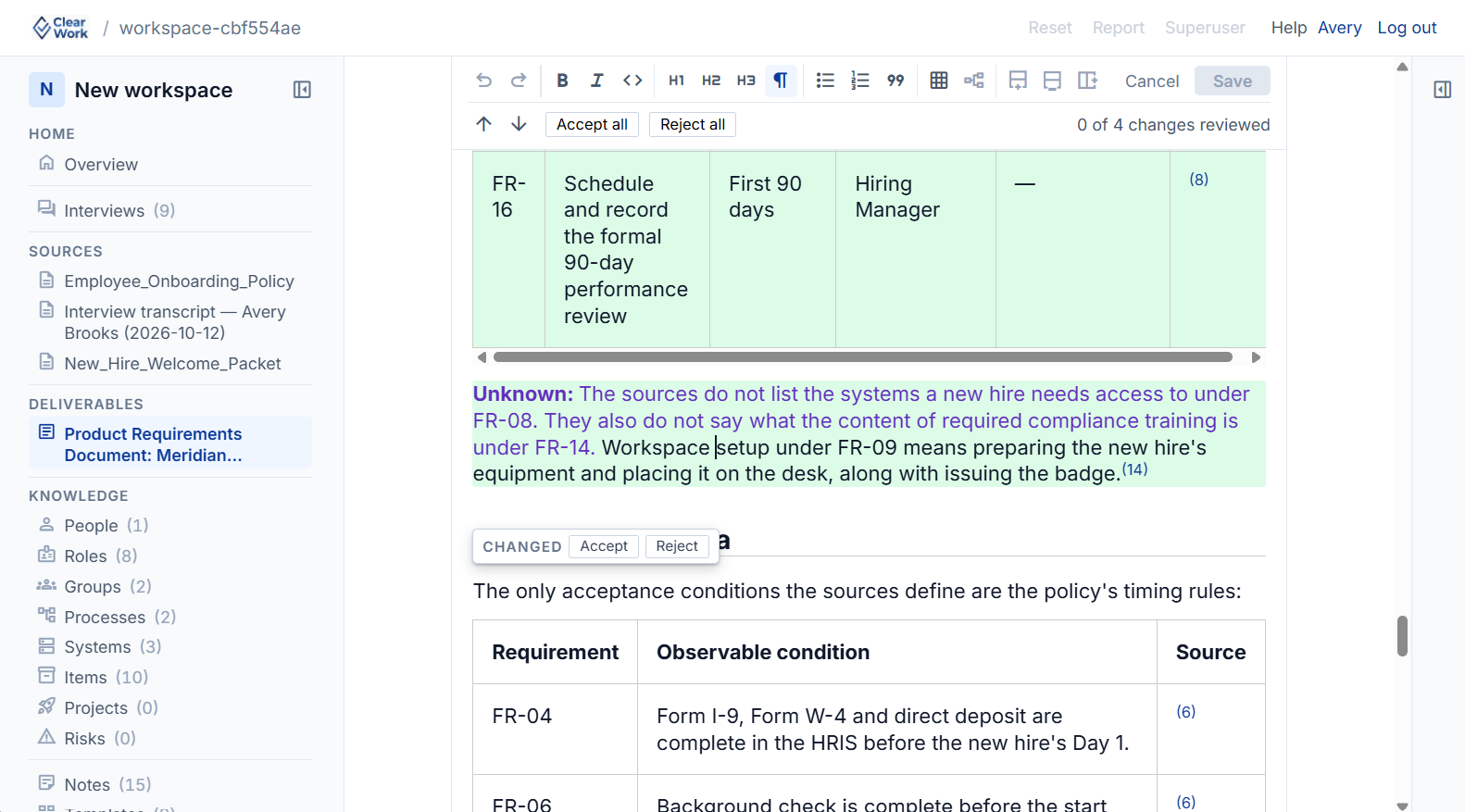
Findings arrive as proposed changes — what it is, where it came from, what it affects. You accept, edit or reject.
Fair question, and a different one. Traceability tells you where a line came from — it doesn't tell you the extraction was right.
So the record shows its work. Every claim carries what it pulled and how confident it is. Ambiguity gets flagged rather than resolved quietly. The gate is the answer, not the citation.
When a client challenges a finding in the readout, you don't defend your judgment. You show the source.
"It's the structure. It's managing in a structured way and having that golden thread throughout."
Founder · boutique advisory practice
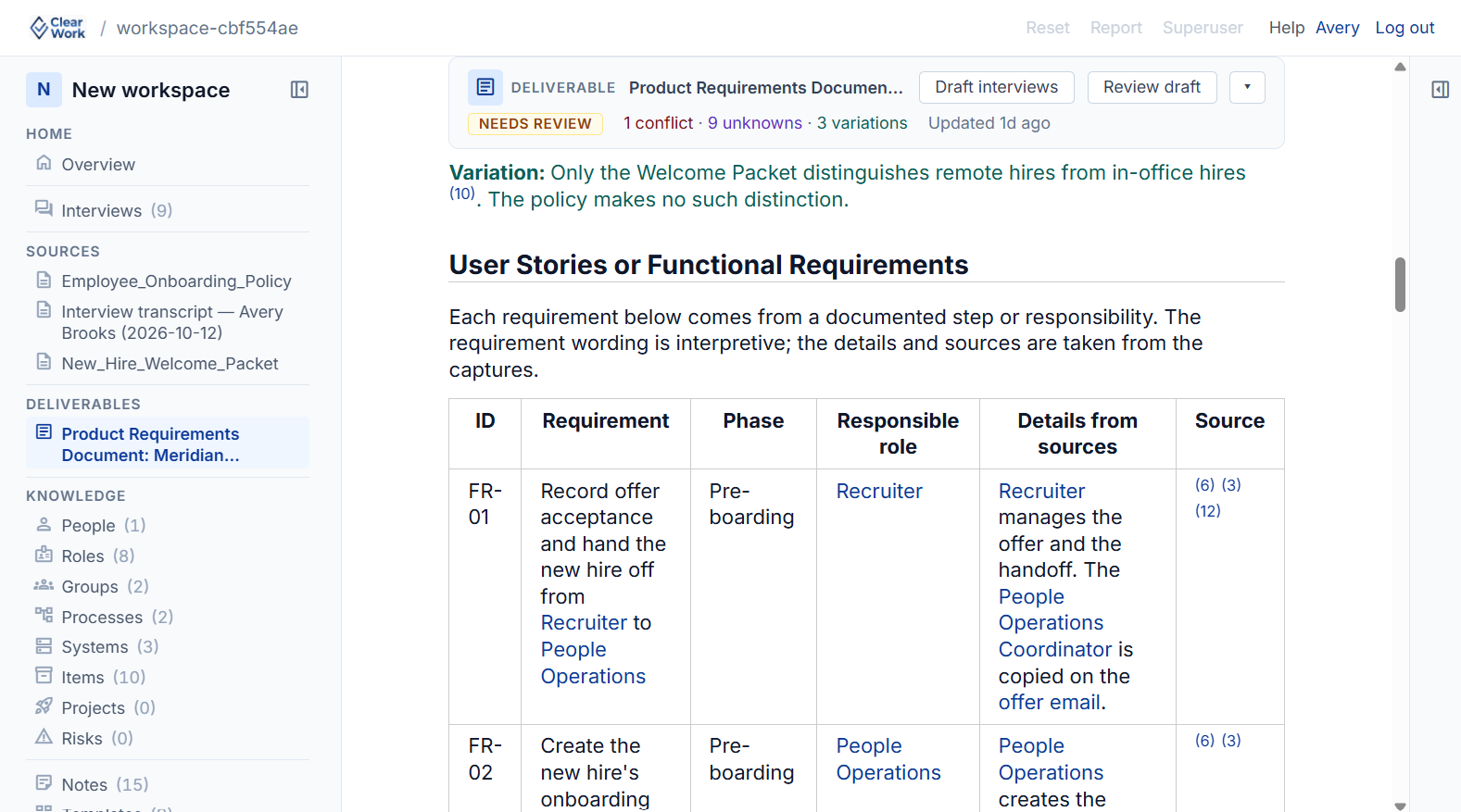
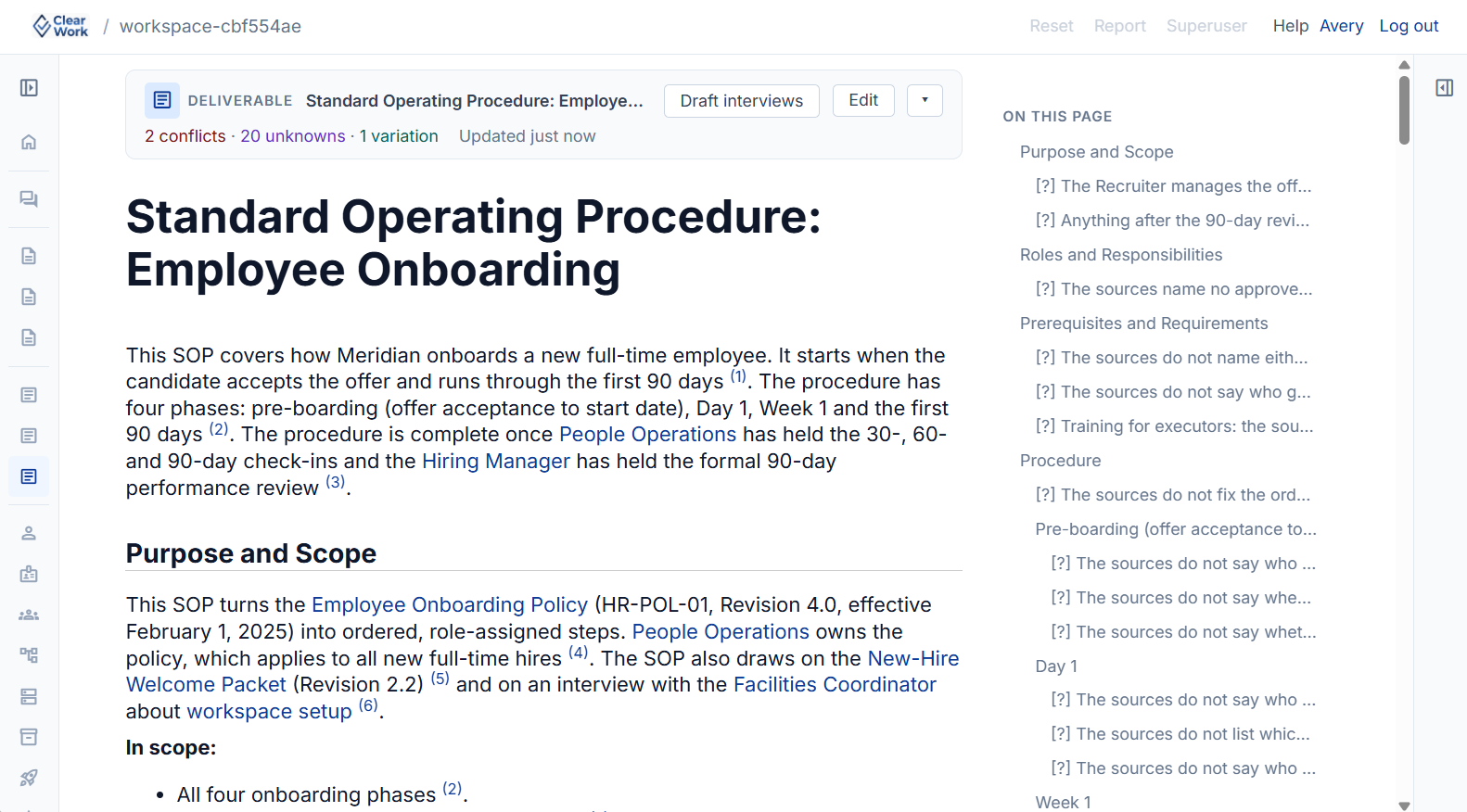
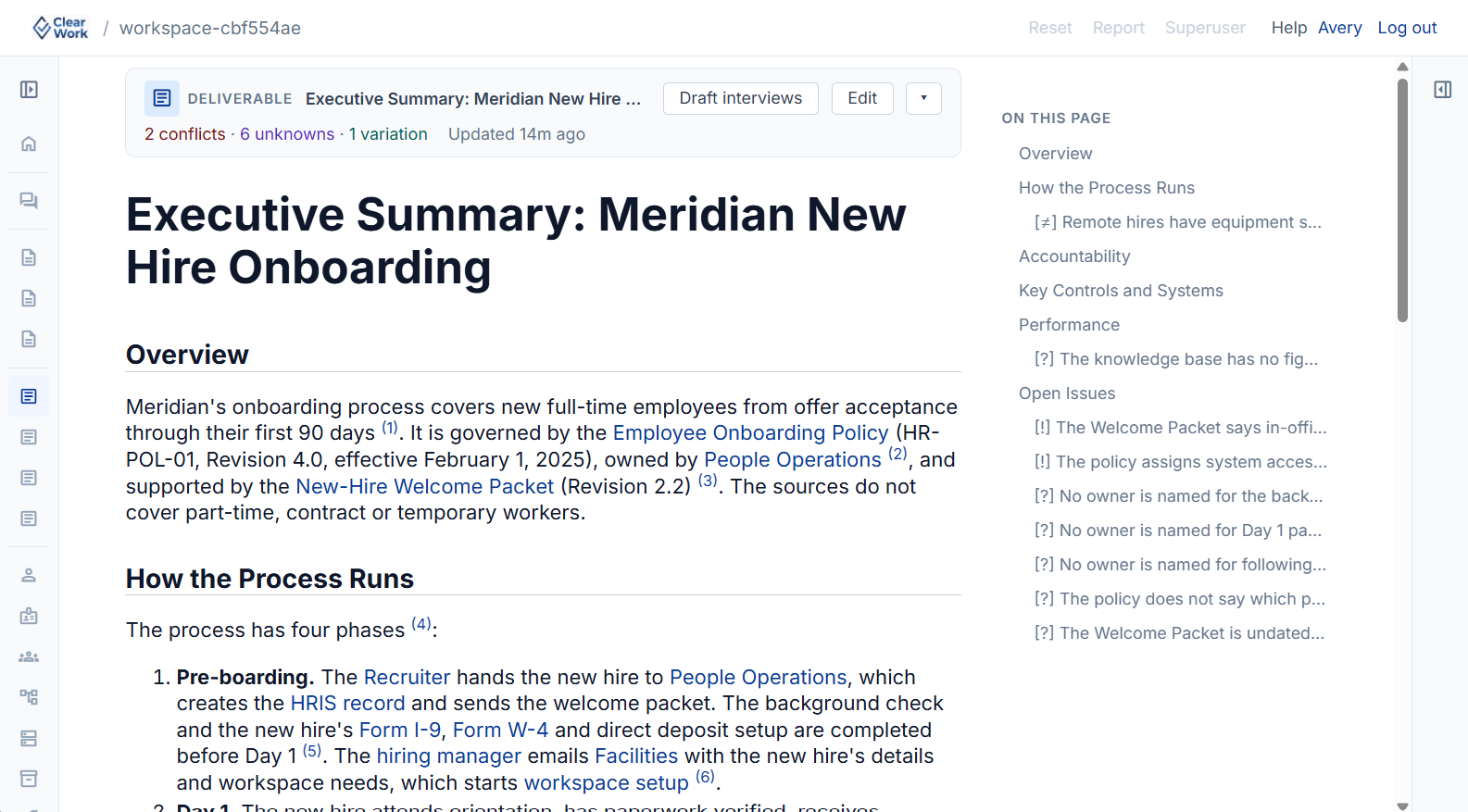
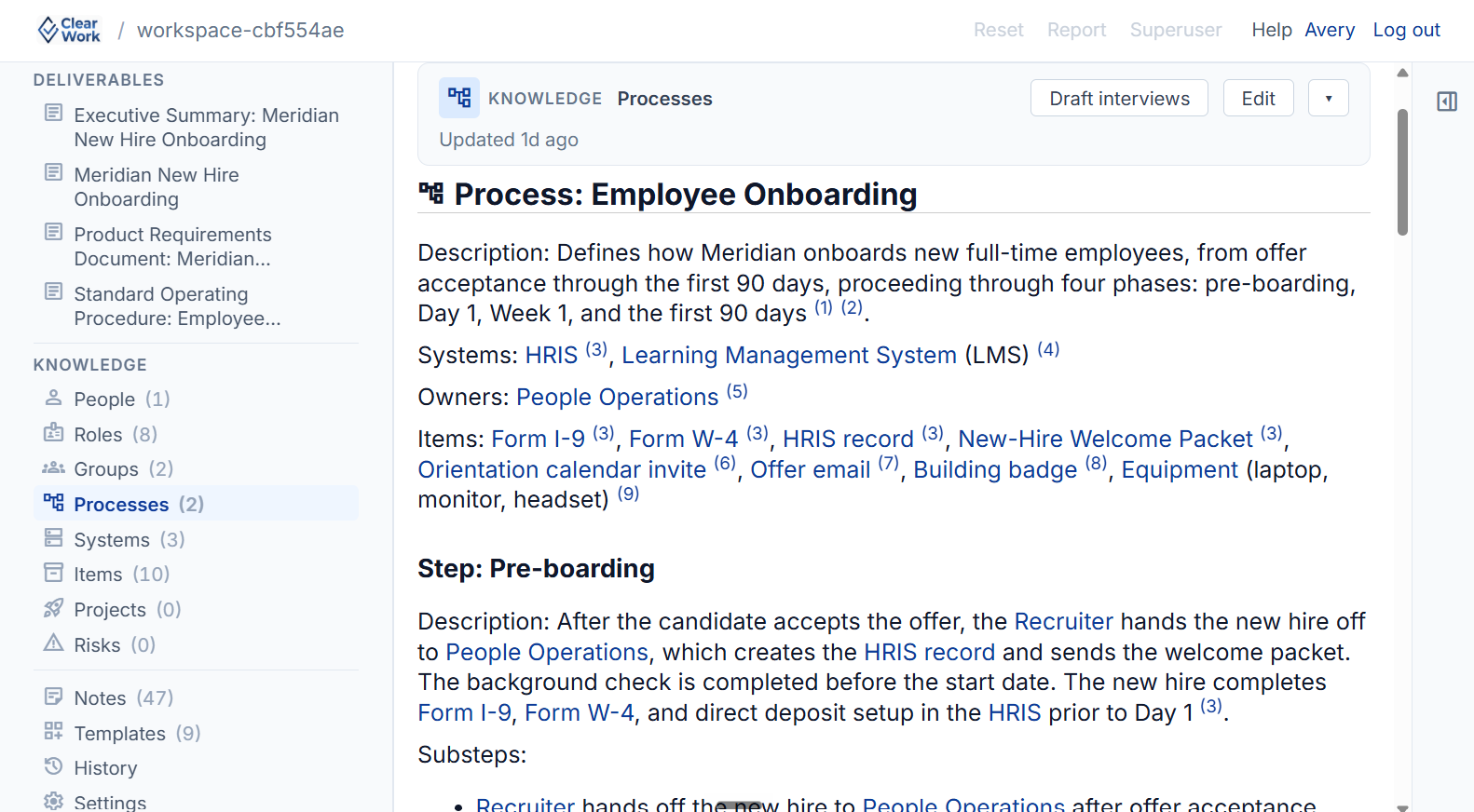
Not blank templates. Populated documents built from your actual engagement — each line carrying the source behind it.
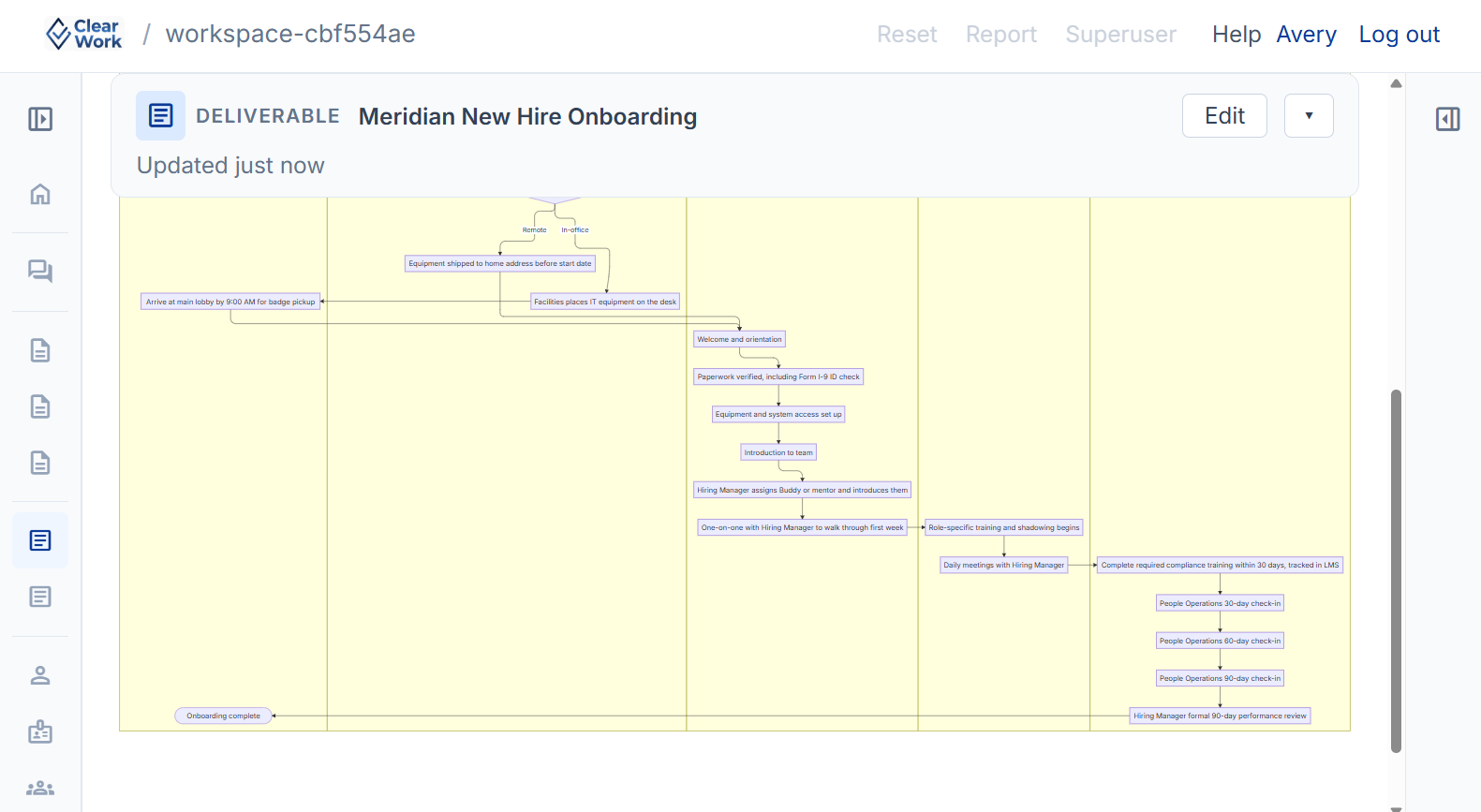
Role-based flows with handoffs, decision points, and the exception paths that only surfaced in interviews.
PRDs, user stories and requirements matrices — each item traced to the source that generated it.
Every line source-linked
Procedure documents drafted from how the work is actually done, not from a template you fill in.
Current-state reads and client-ready narratives grounded in the validated record.
They were never paying you to interview twelve people.
They were paying you to know what to do with what those twelve people said. Discovery was the tax you charged for the real work. Take the tax off the bill and you win more proposals — and spend the engagement on the recommendation instead of the notes.
Same fee. More of it spent on the part they can't get anywhere else.
Consulting firms bill by engagement, so we price by engagement. Internal teams run continuously, so we price by user.
14-day free trial with unlimited use. Cancel anytime. No card required.
Discovery you can defend, deliverables you can trace, and margin that survives a fixed fee.
For consultants →Turn the knowledge that lives in your people's heads into process standards that stay current after the project ends.
For internal teams →Not a canned demo on invented data. Drop in a scope doc, a recording and a couple of SOPs from a live project, and see the record it builds.